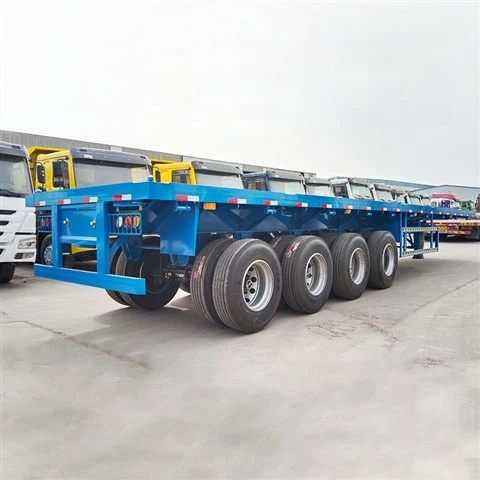
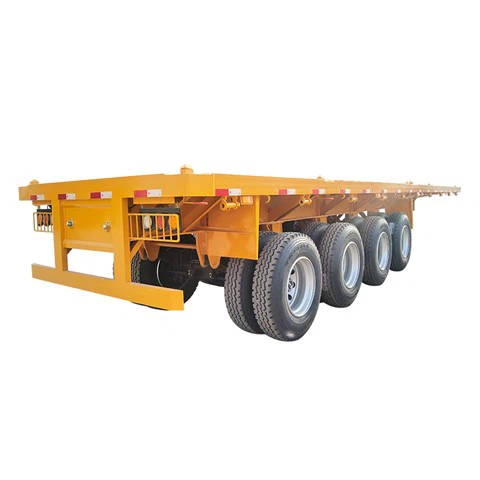
Flatbed Trailer

Why choose us?


Chengda: Your Professional Flatbed Trailer Manufacturer!
 

Shandong Chengda Auto Sale Co., Ltd. established in 2005 is one of the qualified manufacturers of various trailers. Integrated production, scientific research & development, and professional sales teams, all those advantages can provide the full service of semi-trailers, tractor heads, dump trucks, engineering machinery, and trailer parts, our company is a leading provider in this industry.

01/

Complete models

The strength, stiffness, and toughness of the frame are considered in a balanced manner, and it has the characteristics of strong load-bearing capacity and non-deformation.

02/

Worry-free after-sales service

All concrete mixer trucks are produced according to standards to ensure quality.

03/

Strong production capacity

It has introduced and established an international management model, an extensive sales network, and a strong technical development force to create a reliable lifting machinery manufacturing enterprise to meet the needs of different markets and multiple uses.

04/

Improve the quality assurance system

The company has a full range of mechanical processing equipment, various physical, electrical, hydraulic, chemical, and other testing methods, and has established a reliable quality assurance system.

 

First Prev 1234567 Next Last 1/15

What is the flatbed trailer?


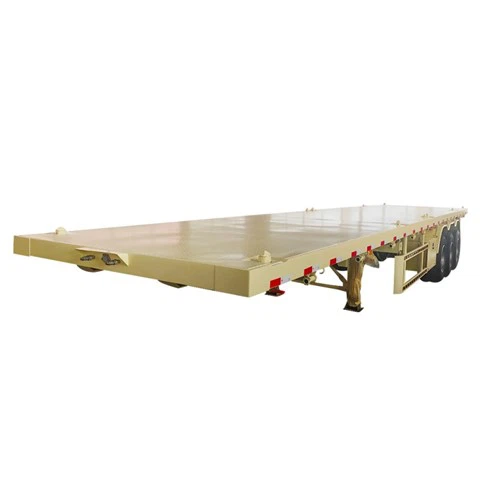
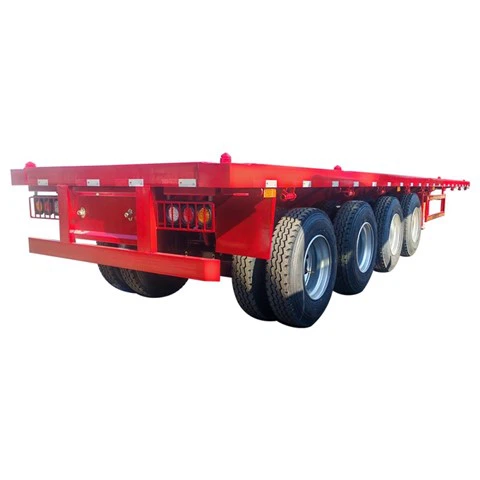
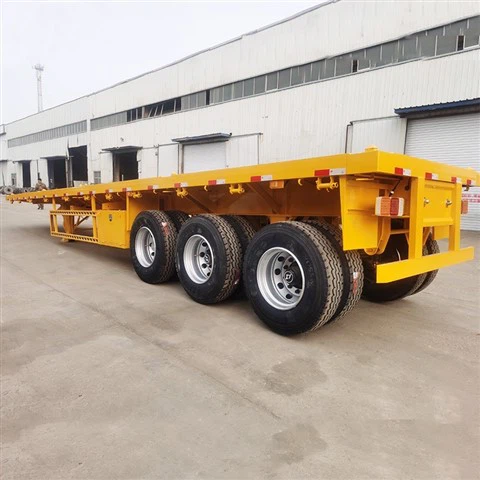
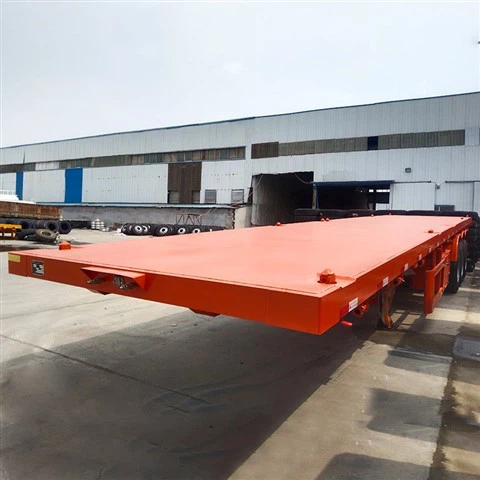
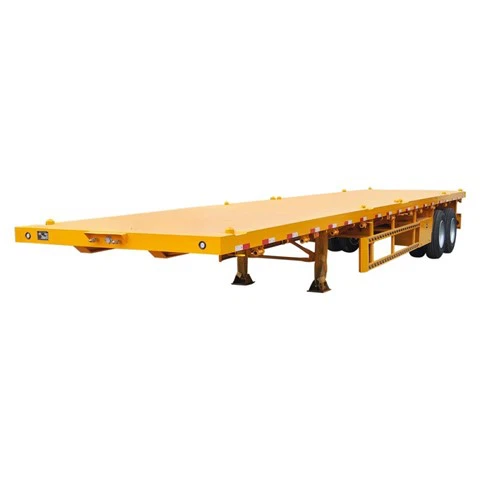
A flatbed trailer is a typical open-deck unit with neither a roof nor sides. It is mainly used for transporting heavy, oversized, wide, and unrefined cargo such as machinery, construction supplies, or equipment. The flat body makes loading and unloading cargo easier.

Since the body of the flatbed container trailer is open, the goods transported with it must not be easily affected by rain. Due to its versatility, trailers are among the most commonly used. Generally, trailer lengths range from 40 to 53 feet.

This is a long, flat platform designed to carry 40-foot, 45-foot, or 53-foot shipping containers.

Types of flatbed trailer


Flatbed container trailers are generally classified according to the number of axles, such as common 2 axle flatbed trailers, 3 axle flatbed trailers and 4 axle flatbed trailers.

Benefits of flatbed container trailer


Simple loading

Flatbed trailers can carry most items you can think of, space permitting.

01

Size Variety

As transportation needs vary, so do the sizes of flatbed trailers.

02

Towing capacity

Flatbed container semi trailer trailers are designed for durability and power. Flat bed trailers can easily tow other vehicles or wheeled equipment.

03

Affordable

Flatbed container semi trailers are one of the most economical vehicles used for transportation. And the maintenance requirements of the vehicle are quite low. The price of the trailer is also in line with the market demand.

04

What are the Applications of Flatbed trailer?


Flatbed trailers are popular, especially for transporting irregularly shaped cargo such as pipes, steel, lumber, blocks, construction equipment, or larger vehicles that do not fit on a traditional dry van trailer such as a truck.


Product Specification


Item

Value

Loading Weight( KG)

40 - 80 tons

Axle Brand

ZY / FUWA / JOST optional

Axle Number

2 / 3 / 4 optional

Suspension system

Mechanical Leaf Spring Suspension

Leaf spring

90(W)mm*16(Thick)mm*10 Layer

The material of Main beam

Q345B carbon steel,The height of the beam is 500 mm, upper plate is16mm,down plate is 18mm, middle plate is 10 mm.

Tire

12R22.5

Rim

9.0*22.5 steel disc wheel, 10 holes ISO

Brake system

Dual Line braking system / ABS.

Landing Gear

Standard 28ton

Brake air chamber

Six big chamber

Electrical system

Voltage: 24v
Receptacle: 7 ways (7 wire harness)


How to maintain the flatbed trailer?
 

On endless highways and in all weather, your flatbed trailer must be in top condition to withstand daily wear and tear. Use these slab maintenance tips to make sure your equipment is up to the task before minor issues become costly and potentially dangerous.

Tire Air Refill

Maintaining proper air pressure is critical to extending the life of your trailer tires. Check all tires regularly using a properly calibrated air pressure gauge and check for punctures, cuts, or damaged valve stems.

Wheel end

Regularly check all hubcaps for leaks to prevent water seepage, and check wheel ends for proper lubrication and water contamination. Water intrusion can cause bearings and seals to fail, leading to axle damage.

Landing gear

Pressure wash the landing gear and undercarriage to remove any dirt or grit that has accumulated during use. Lubricate grease joints. Check the attachment points on the landing gear and brackets for proper torque levels.

Test engine

Test for warning signs such as extreme smoke, loss of oil pressure, or loss of power.

Certifications


Chengda Certificate

FAQ

Q: 1.What is a trailer in transport?

A: A trailer is a container on wheels pulled by a car or another vehicle used to transport large or heavy cargo. In basic terms, the trailer is an unpowered vehicle usually towed by a powered vehicle. This type of vehicle is mostly used to transport large quantities of goods by road.

Q: 2.How do you use a flatbed trailer?

A: You should place about 60% of the cargo on the front half of your flatbed and 40% on the back half. Secure it with tensioning devices, chains, straps or other appropriate equipment. Flatbed trailers are often bumpy when in motion, so securing the load well is vital.

Q: 3.How does a flatbed work?

A: Unlike your standard pickup or box truck, a container semi trailer is equipped with an open trailer or bed that allows you to load your cargo directly onto it. There's no roof and no walls to get in the way of your cargo — or your loaders.

Q: 4.Why use a flatbed trailer?

A: As the name suggests, a flatbed semi trailer provides an entirely flat and level bed that lacks any sides or roof. The main advantage that comes with such a setup is convenience, especially when loading heavier pieces of cargo. There's no lip to lift things over, and you can load from any direction you want.

Q: 5.How many types of trailers are there?

A: 20 Different Types of Trailers. Depending on what's being transported, each trailer will be different. For example, food and packages will be commonly found in enclosed trailers while gas is in a tanker truck. Different cargo requires a different trailer, so let's look at them all.

Q: 6.Why use a flatbed container semi trailer?

A: As the name suggests, flatbed trucks offer a completely flat and level bed without any sides or roof. The main advantage of this setup is convenience, especially when loading heavier cargo. There is no lip to lift things and you can load from any direction.

Q: 7.What are the different sizes of flat bed trailers?

A: Everything you need to know about flat bed semi trailer dimensions. Typically, a standard flatbed trailer is 45 feet in length. However, it's worth noting that differences do exist, such as 40-foot and 53-foot trailers. Understanding standard dimensions can help ensure proper planning and compatibility with loading docks and shipping facilities.

Q: 8.Which type of tow truck is the most profitable?

A: Flatbed trailer
Flatbed truck drivers earn more per mile than most other towing types, which helps with driver turnover. There are plenty of pick-up and delivery opportunities every week.

Q: 9.What's the difference between a trailer and a truck?

A: A truck is a vehicle powered by its engine and driven by a person. A trailer is a mobile cargo space that's designed to be pulled by a separate vehicle. A trailer cannot be run or driven on its own. A truck can use different types of trailers to fit whatever the job requires.

Q: 10.What is the most common flatbed freight?

A: Lumber & Other Building Materials. Flatbed carriers offer many types of construction trucking services, like lumber, metals, concrete, limestone, and other building materials.

Q: 11.What is the purpose of a flatbed trailer?

A: A flatbed trailer is a large vehicle with a flat body and no sides or roof around the body. Typically, the heavy loads these trailers transport are unaffected by bad weather or rough roads.

Q: 12.What are the benefits of flatbed container trailers?

A: Not only can flatbed semi trailers handle heavy and large loads, but they also give you the freedom to transport items of any shape or size. With a container trailer, you are not restricted by the sides or top, which means you can easily stack items up and to the sides.

Q: 13.What is the difference between a flatbed and a van trailer?

A: Compared to a dry van, a flatbed trailer is designed without walls or a ceiling. Because it has no top and no sides, it allows truckers to load from various angles and facilitates the shipment of large machinery that wouldn't fit in a concealed container.

Q: 14.What are the most common types of flatbed trailers?

A: 48ft Flatbed Trailer
In addition to dry vans, standard flatbed trailers are a prevalent type of trailer. Although they come in many sizes (40, 45, 48, and 53 feet), the 48-foot flatbed trailer is the most commonly used.

Q: 15.What are the characteristics of a flatbed trailer?

A: A flatbed trailer is a trailer with a flat deck and no sides or roof. Flatbed container trailers are a type of semi-trailer with a unique lathe design and are usually used to transport large or heavy goods. They are particularly suitable for asymmetrical or wide loads that may not fit on a trailer with walls or a roof.

Q: 16.What is a flatbed semi trailer in freight?

A: Flatbed shipping is suitable for transporting cargo that may not require a dry van enclosure, cannot be loaded and unloaded from a dock, or does not fit into standard truck trailer dimensions. The design of container trailers allows cranes and forklifts to load cargo from all angles.

Q: 17.Can containers be loaded on flatbeds?

A: If you need to transport a container more than 200 miles, a flatbed trailer is your best choice. This is because tilt-flat trailers have higher operating costs than flatbed trailers, especially when comparing the two on a per-mile basis.

Q: 18.Can you put a 40 ft container on a flatbed trailer?

A: A regular chassis can haul 20-foot and 40-foot containers with only two axles. A tri-axle chassis is required to transport 20ft containers weighing more than 36,000 pounds or 40ft containers weighing more than 44,000 pounds.

Q: 19.What are the dimensions of a container semi-trailer ?

A: Depending on your cargo, some trailers are better suited to your needs. Current standard container dimensions are 53 feet or 48 feet long and 102 inches or 96 inches wide (53 feet x 102 inches and 48 feet x 96 inches). There are different sizes available for transporting your goods.

Q: 20.How do you measure a flatbed trailer?

A: A flatbed semi-trailer's trailer length is measured from the front of the axle to the end of the trailer and is typically 27 to 31 feet long. A semi-trailer's overall length is measured from the front bumper to the rear and includes all attachments thereon.


As one of the most professional flatbed trailer manufacturers in China, we warmly welcome you to buy quality flatbed trailer for sale at good price here. All products offered in our factory enjoy one year warranty.